Tencent Launches Full-Scale 'Lobster Counterattack'
By Song He, Huang Yu
On March 11, Tencent announced the launch of SkillHub—a China-optimized AI skills community built on the OpenClaw (Lobster) open-source ecosystem. This localized configuration service is fully compatible with the official OpenClaw community’s skill ecosystem.
This marks just one footnote in a series of large-scale moves Tencent has made in the AI space around the OpenClaw ecosystem within a mere six days.
Starting at 10 a.m. on March 6, 2026, Tencent deployed engineers to its headquarters in Nanshan District, Shenzhen, to offer free installation of OpenClaw services. Users eager to try it lined up for hours, stretching all the way from the plaza to across the street.
Even more unexpectedly, during a group meeting of Guangdong’s National People’s Congress delegation the following day, Chinese Academy of Engineering academician and director of Pengcheng Laboratory Gao Wen delivered a remark that drew knowing smiles from the audience: “The craze for raising lobsters is so big—even Ma Huateng didn’t expect it.”
Ma Huateng may indeed have been surprised. But Tencent’s response speed has clearly exceeded market expectations.
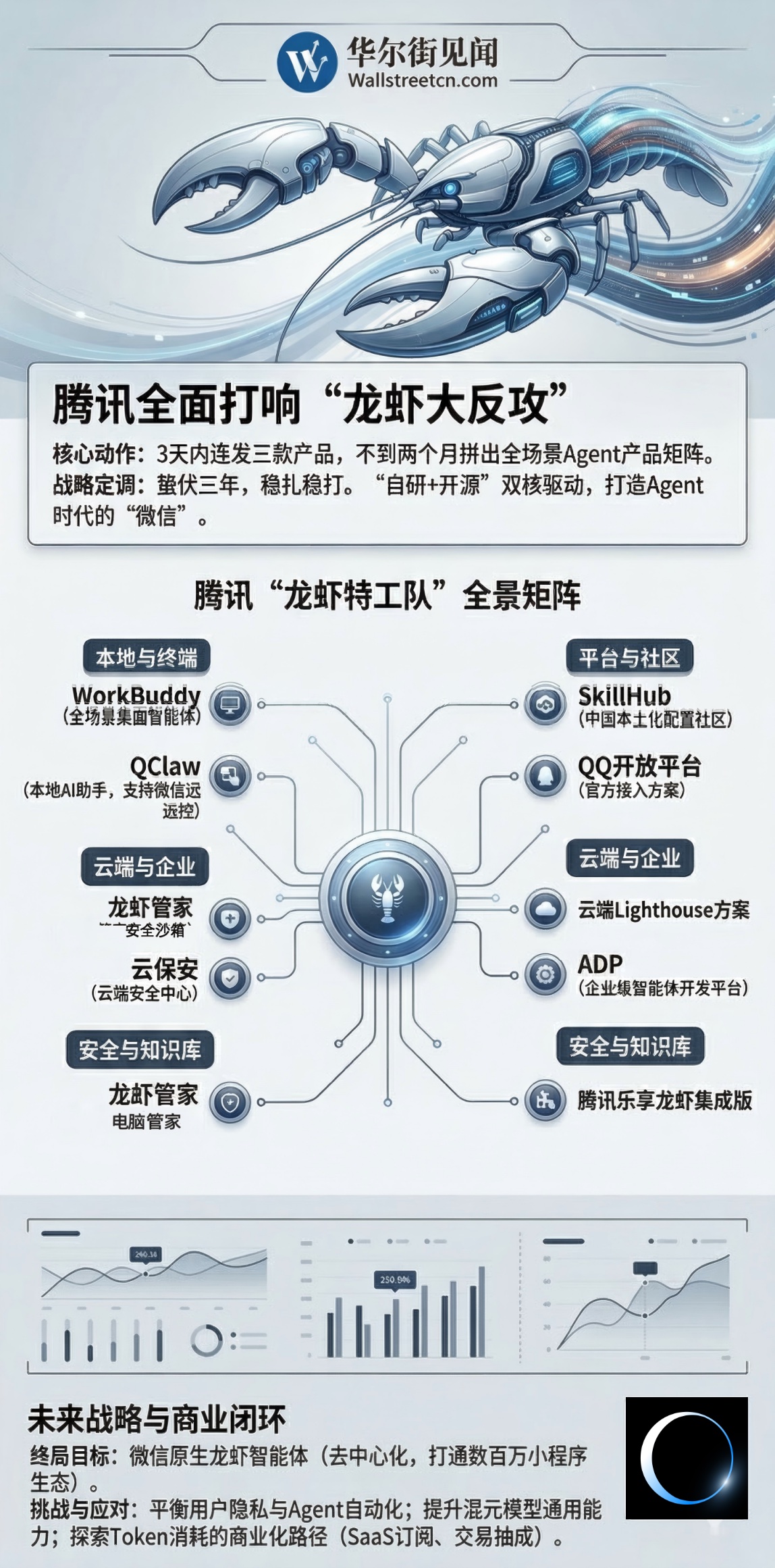
Just three days later, on March 9, Tencent unveiled three new Lobster products in quick succession: WorkBuddy, a self-developed, full-scenario desktop AI agent featuring zero deployment and zero configuration—accessible directly through any browser; QClaw, a local AI assistant based on OpenClaw, quietly entering internal testing, offering one-click installation on both Windows and Mac platforms and supporting remote control via WeChat, with data fully stored locally; and the full integration of OpenClaw’s official solution into the QQ Open Platform.
On March 10, Tencent officially branded these products collectively as the “Lobster Special Forces” under a vividly descriptive name.
Adding to this lineup are previously launched offerings: Tencent Cloud Lighthouse, the cloud-based OpenClaw solution with over 100,000 users; ADP, an enterprise-grade AI agent development platform; Tencent PC Manager’s AI security sandbox, “Lobster Guardian”; the cloud-based AI Agent security center, “Cloud Security Guard”; and the Lobster-integrated version of Tencent LeXiang knowledge base.
Within less than two months, Tencent has rapidly assembled a comprehensive, end-to-end Agent product matrix spanning individual users to enterprises, from local deployment to cloud services, and covering security to knowledge management.
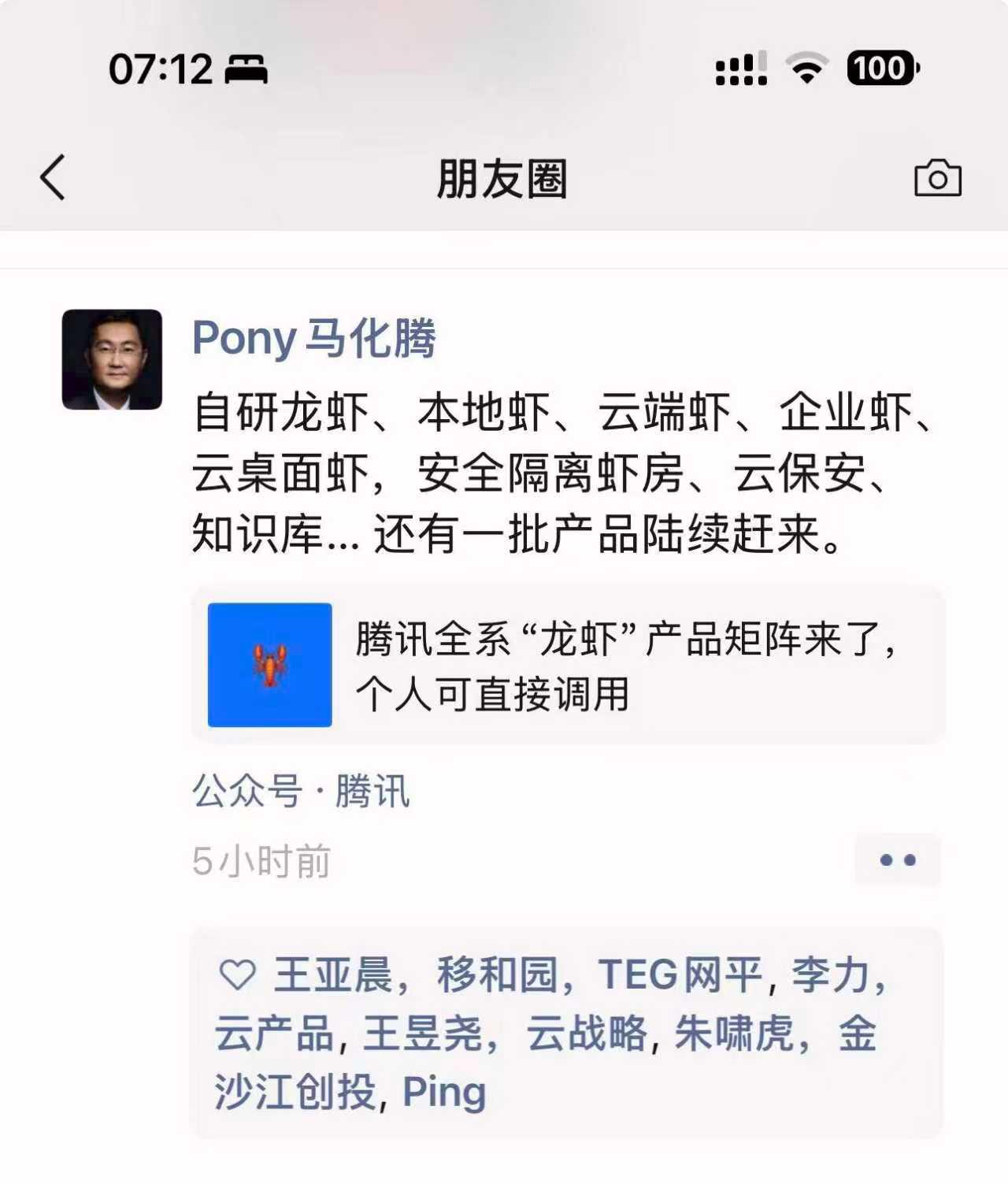
As Ma Huateng put it on his Moments feed: “Self-developed lobster, local lobster, cloud lobster, enterprise lobster, cloud desktop lobster, secure isolation lobster rooms, Cloud Security Guard, knowledge base… and a batch of other products are on their way.”
This was a counterattack without prior announcement. Its irony lies in the fact that just months ago, the market mocked Tencent as the “old man stock” of the AI era.
Yet the current actions and plans represent only the beginning of Tencent’s broader AI strategic deployment.
From the current Lobster ecosystem to future WeChat Agents, this counterattack by a $5 trillion internet giant has only just begun.
The Turning Point for Giants
To understand Tencent’s seemingly counterintuitive move into the Agent space, one must first examine its early-stage performance in the AI era—widely perceived as “sluggish.”
In May 2023, amid the heated “Hundred Models War,” Ma Huateng surprised investors by saying: “We’re not rushing to launch half-finished products. For industrial revolution, launching an electric bulb a month earlier doesn’t matter much over the long term.”
While sounding visionary, the market wasn’t convinced.
In 2024, Douyin’s Dobo rapidly captured the consumer AI application market through algorithmic traffic bias and seamless user experience, surpassing 10 million daily active users by late 2025. In early 2026, Alibaba’s Qwen aimed to dominate user mindshare by focusing on “task assistance,” fully integrating into Taobao, Alipay, Fliggy, and AutoNavi ecosystems in January. Meanwhile, Baidu Intelligent Cloud had already embraced the OpenClaw open-source ecosystem, launching one-click deployment service as early as February 3, just before Lunar New Year.
Meanwhile, Tencent’s Hunyuan large model lagged behind ByteDance and Alibaba in C-end metrics. The promotion of Yuanbao, leveraging WeChat’s social graph for viral spread, also faced backlash due to excessive user intrusiveness.
Even with a 1 billion yuan red packet campaign during the Spring Festival, which briefly pushed daily active users past 50 million, Tencent still faced criticism over high user acquisition costs failing to generate loyalty.
An insider close to Tencent told Wall Street Journal that, compared to large language models, Tencent had focused more energy on multimodal model development, delaying Hunyuan’s entry into the industry’s top tier.
Thus, a stark contrast emerged: despite owning WeChat and QQ—two super-apps with over 1.5 billion monthly active users—Tencent had fallen behind ByteDance and Alibaba in AI applications.
Investor anxiety grew. After reaching a peak of HK$683 in October 2025, Tencent’s stock entered a prolonged downward spiral, eventually dropping to HK$560 by early 2026, with market capitalization briefly falling below HK$5 trillion.
At the same time, the label “Tech Old Man Stock” began circulating online—implying Tencent, with its stable core business and slow innovation, was merely a retired elder relying on past glory in the AI era.
Ma Huateng clearly recognized the issue.
At an employee meeting on January 26, 2026, he openly addressed the criticism of being “slow.” He admitted that initial delays stemmed from various business units prioritizing their own scenarios in AI deployment, resulting in sluggish overall action. Only by the end of 2024 did the Yuanbao team complete its integration from TEG to CSIG. He also announced a full restructuring of Tencent’s AI R&D team—appointing Yao Shunyu, former senior researcher at OpenAI, as Chief AI Scientist in December 2025, and establishing new departments: AI Infra, AI Data, and the Data Computing Platform Department.
But he added a thought-provoking remark: “Every company has different genes and body types. Tencent’s style is steady and solid.” He emphasized that AI is currently the only area worth massive investment. Tencent’s AI strategy is a dual-core approach of “self-development + open source”—“similar to our past in gaming, where we balanced self-developed games and licensed operations, ultimately delivering the best user experience.”
Looking back, this statement already laid the groundwork.
Tencent has never rejected open-source models in the AI model layer. First, it fully integrated DeepSeek-R1, causing Yuanbao’s DAU to surge over 20-fold and jump into the top three in China. Then, when OpenClaw went viral, Tencent Cloud Lighthouse launched its one-click deployment template as early as January 28—earlier than Alibaba Cloud and Baidu Cloud.
Perhaps what appeared as “lagging behind” was simply Tencent waiting for a battlefield it truly excels in.
A little-known detail about OpenClaw’s explosion: the framework initially appeared in late 2025 under the name Clawdbot, generating almost no buzz. It only gained traction after Claude Opus 4.5’s release—same framework, same code, but a stronger underlying model finally made it work.
Recall that in 2024, several similar Agent projects existed, none achieving success. But this time, agents finally felt “grounded” by the model.
OpenClaw’s setup barrier has long been common knowledge: configuration is too complex for average users. Setting up Node.js environments, troubleshooting errors, and configuring API access for Feishu or Enterprise WeChat—all steps pose challenges for non-technical users.
This is precisely Tencent’s sweet spot.
Reviewing Tencent’s two-decade product history, one consistent thread stands out: it may not be the original technology innovator, but it consistently leads in turning complex technologies into products anyone can use. QQ did it, WeChat did it, WeChat Pay did it, and Mini Programs did it.
In the Lobster game, Tencent chose the same path: not a pioneer in foundational models, but the largest productization platform in the Agent era.
Huoshan Engine President Tan Dai once predicted: “In the PC era, the core was Web; in the mobile era, it was Apps; in the AI era, it’s Agents.” If this holds true, Tencent’s role will be the “App Store” and “WeChat” of the Agent age.
Facing external skepticism, Ma Huateng opened the 2026 Tencent employee meeting with reassurance: “Stay focused, maintain discipline, stick to our own rhythm.” He reiterated: “Each company has different genes and body types. Tencent’s style is steady and solid.”
Clearly, after three years of dormancy, Tencent will accelerate its AI strategy in 2026. An insider revealed that internal expectations anticipate major AI moves throughout the year.
The Future of WeChat Agents
As the public sees it, Tencent launched a meticulously layered “Lobster Special Forces” matrix around OpenClaw in March 2026—covering novices, hardcore developers, and large enterprises, aiming to demolish the usage barrier of “Lobster.”
But while everyone focuses on the Lobster product suite, the real ace card remains hidden beneath the surface.
At the 2025 annual earnings call, when asked about the Agent strategy, Ma Huateng made a crucial statement: “Everyone can create general-purpose intelligent agents. But there’s another kind of agent that exists within WeChat and its unique ecosystem. I see these as two distinct products.”
He elaborated: “For general-purpose agents, Tencent is building such capabilities in AI-native products like Yuanbao and Ima. Initially, they’ll just answer questions quickly, then gradually add chain-of-thought reasoning and long-chain inference, followed by more complex automation tasks. But they won’t differ much from other agents offered by competitors.”
What truly lit up Ma Huateng’s eyes, however, was the potential of WeChat-native agents.
WeChat’s ecosystem features unique components: social graphs, communication and community capabilities, content ecosystems including Official Accounts and Video Channels, and millions of mini programs within WeChat.
“These mini programs involve diverse information and cross numerous vertical applications, enabling transactions and operations. Compared to more generic agents, this is extremely unique. For Tencent, this is a highly differentiated product,” Ma said.
The weight of this statement is immense. It signals that Tencent’s leadership has explicitly positioned WeChat Agents as a standalone, strategic product—not merely adding an AI feature to WeChat.
But WeChat’s Agentification is far more complex than imagined.
At the January 2026 employee meeting, Ma Huateng’s stance on WeChat AI seemed cautious: “An AI all-in-one package isn’t necessarily loved by everyone. We’ll continue to uphold decentralization, thinking carefully about WeChat’s intelligent ecosystem with user needs and privacy safety in mind.” He specifically noted that for the WeChat business group, “more time and patience are needed—plan thoroughly before acting.”
This “cautiousness” reflects deeper logic.
WeChat’s 1.3 billion monthly active users represent China’s most precious digital asset—covering nearly every Chinese person’s social network, payment behavior, information consumption, and lifestyle services.
A wrong product decision could cause irreversible damage to user trust. The philosophy of “restraint” established during Zhang Xiaolong’s era—no excessive commercialization, no forced feature rollouts—was the foundation of WeChat’s victory over QQ in the IM wars and its dominance in the mobile internet era.
But the Agent era fundamentally challenges this philosophy.
The core capability of an Agent is “doing things for you”—requiring access to your contact list, reading messages, calling payment accounts, and operating saved mini programs. This creates inherent tension with WeChat’s long-standing “user privacy first” principle.
This likely defines a red line for Tencent’s own Agent path: WeChat Agentification must proceed within a safe and controllable framework.
Thus, gradual, phased testing may become the necessary path before full rollout.
Tencent has a well-tested product logic: new features and forms are first validated on QQ before being gradually rolled out to WeChat.
The Lobster deployment sequence mirrors exactly this order.
First step: full QQ open access. On March 7, the QQ Open Platform officially opened official OpenClaw integration to individual users—zero coding required to create AI bots. QQ’s younger user base, highly receptive to new tech and willing to experiment, serves as the ideal early adopters for Agents. Compared to the complex processes required on Feishu (creating custom apps) or DingTalk (setting up test organizations), QQ’s “raising lobsters” process is significantly simpler.
Second step: QClaw’s indirect strategy. WeChat Open Platform has never opened official robot APIs to personal WeChat accounts.
All existing personal WeChat robot solutions rely on protocol reverse-engineering or Hook methods—non-official, “wild” integrations carrying risks of account bans and compliance issues. QClaw’s clever twist: it connects to personal WeChat via Enterprise WeChat’s “WeChat Customer Service” entry. The Lobster runs on the user’s own computer, while WeChat acts only as a command interface.
This is a compromise between cloud and local—allowing users to chat with Lobster in WeChat without requiring WeChat to open low-level APIs.
If QClaw retains direct personal WeChat connectivity upon official launch, this would mark the first official integration of Agent robots into WeChat.
Third step: the ultimate goal—native WeChat Lobster agents. While not officially confirmed, multiple media reports suggest Tencent is planning a chat-based Agent embedded directly into WeChat, connecting the millions of mini programs to enable tasks like ride-hailing, food delivery, medical appointments, and ticket booking. This product may launch between mid-2026 and Q3.
Challenges Remain
First, the primary obstacle comes from the front end—the biggest potential enemy might be WeChat itself.
WeChat has long been known for its “restraint.” As Zhang Xiaolong repeatedly emphasized, it’s wary of overloading features.
Major updates—from Moments to WeChat Pay to Mini Programs to Video Channels—have always undergone lengthy internal discussions and extremely cautious gray-scale testing.
This culture ensures product quality and user trust but also means WeChat naturally lags behind competitors by one or two beats when facing fast-changing technological trends.
Ma Huateng’s assessment of the WeChat business group at the employee meeting—“how to integrate new technologies based on our unique traits, with more time and patience, plan carefully before acting”—is both a reassurance to outsiders and a shield for the WeChat team. But the window of opportunity for WeChat is not infinite.
If WeChat Agent fails to materialize, users may grow accustomed to completing “tasks for me” via Dobo or Qwen. Once habits form, even if WeChat later launches a better Agent, the migration cost will be a formidable barrier.
Tencent may use QClaw and other Lobster products as informal pilots to gauge real user demand. The behavioral data accumulated from these products could directly influence the timing and method of official Agent integration into WeChat.
In a sense, QClaw is effectively a real-time survey on the feasibility of a WeChat Agent.
Second, backend model capabilities remain a critical gap needing urgent improvement.
Although Tencent’s self-developed Hunyuan model maintains leadership in multimodal fields, in general language ability, Dobo, Qwen, and DeepSeek have already captured more user attention.
Tencent currently adopts a “self-developed + open source” dual-core strategy. Tang Daosheng explicitly stated at the earnings call: “Tencent’s AI strategy is a multi-model approach of ‘core technology self-development + proactive embrace of open source.’ We are firmly advancing full-stack self-development of large models while actively adopting advanced open-source models, allowing users to freely choose models for different scenarios. WorkBuddy supports domestic models like Kimi and MiniMax; QClaw also allows custom model integration.
The brilliance of this strategy lies in “not putting all eggs in one basket”—not forcing self-developed models to win in every dimension, but instead using product-layer integration to deliver the “best model routing” for users.
But the risk is clear: if Tencent never develops a sufficiently strong self-developed general-purpose model, it will forever remain a “assembler” rather than a “core supplier” in the Agent ecosystem—leaving the bulk of profit from API and Token usage to the underlying model providers.
Ma Huateng expressed in the Q3 2025 report: “We continuously upgrade the Hunyuan foundational model’s team and technical architecture. As Hunyuan’s capabilities improve, our efforts to promote Yuanbao adoption and develop AI agent capabilities within WeChat will yield increasingly positive results.”
In 2024, Tencent’s R&D spending reached 70.69 billion yuan. In the first three quarters of 2025, cumulative R&D spending reached 61.98 billion yuan, up ~22% YoY. Liu Zhi Ping revealed that 2025 capital expenditure is expected to be in the “low double-digit percentage” of total revenue—potentially approaching the 100-billion-yuan level.
Money is being poured in, but catching up in model capabilities takes time. Whether Yao Shunyu—Tencent’s Chief AI Scientist recruited from OpenAI—can achieve a leap in Hunyuan’s general capabilities within the next 12 to 18 months will be a key variable determining the success of Tencent’s Agent strategy.
Third, balancing Agent costs with WeChat’s monetization remains a long-term challenge for Tencent.
It’s widely known that running a complex task on OpenClaw may trigger thousands of model calls. A report from Guolian Minsheng Securities likened Tokens to the “energy of the Agent era”—“raising lobsters” is not a one-time cost but a long-term expense.
If Tencent pushes Agent capabilities to 1.3 billion WeChat users at scale, Token consumption will be astronomical.
In the short term, cost spreading via advertising and business growth subsidizing AI investment may be Tencent’s pragmatic approach. Ma Huateng explicitly stated at the Q3 earnings call: “AI is not a cost—it’s our growth engine across all businesses.”
In Q3 2025, AI-driven ad targeting boosted marketing services revenue by 21% year-on-year to 36.2 billion yuan, maintaining double-digit growth for twelve consecutive quarters. AI has made the “printing press” of advertising more efficient—this is likely the primary funding source for Agent investments in the near term.
But long-term, the Agent business model must cover the massive, unavoidable Token expenses.
According to an insider, three possible paths for monetizing costs: first, Token usage fees—direct charges for cloud deployment, though unlikely for 2C users; second, mini-program transaction commissions—each transaction completed by an Agent could trigger a channel fee for WeChat; third, enterprise SaaS subscriptions—such as fees charged to corporate clients via the ADP platform. For example, OpenClaw users on Tencent Cloud Lighthouse have surpassed 100,000 and continue rising. Developer token usage hits record highs—indicating the “selling shovels” model in the cloud is beginning to take shape.
The Final Battle
Perhaps all current actions must be re-examined against the fundamental first-principle question:
What does this Lobster counterattack mean for Tencent?
Superficially, it’s a giant company catching up in the open-source Agent wave. But viewed over a longer timeline, it may mark the beginning of Tencent’s transformation from a “social platform company” to an “intelligent infrastructure company.”
In the PC internet era, the gateway was browsers and search engines. In the mobile internet era, it was apps and app stores. In the Agent era, the gateway will be intelligent agents embedded in daily communication tools—no need to open any app, just say a sentence in a chat box, and the AI completes everything for you.
Who owns the largest chat window owns the ultimate gateway of the Agent era.
In China, that largest chat window is unequivocally WeChat.
Ma Huateng once said at an earnings call: “AI is still in its early stages. Just as when the Second Industrial Revolution arrived, power plants, grids, and light bulbs were the earliest applications. Later, countless appliances and the internet emerged—all thanks to the development of this ecosystem.” His point: we’re still in the light bulb phase.
But Deloitte predicts the Agentic AI sector will grow at a compound annual rate of 43%, far exceeding other AI segments. CB Insights reports that mentions of “Agent” in public company earnings calls have increased tenfold since 2023. Silicon Valley venture capital guru Vinod Khosla believes 2026 will be the year when Agents mature and produce tangible impact.
The light bulb era may soon end. And when the appliance era arrives, the one who holds the largest power plant and densest grid will be the ultimate winner.
From gateway to closed loop, countless obstacles remain. Can model capabilities support accurate execution of complex tasks? Can the security system give users confidence to hand over operational permissions? Will WeChat’s deeply cautious culture toward openness make room for Agents?
These questions await Tencent’s step-by-step exploration, offensive maneuvers, and continuous feedback loops with users.
But one thing has changed.
In early March 2026, as people flew in from Hangzhou and Hong Kong, lining up for hours to get Tencent engineers to install their red lobsters, a clear signal emerged: AI is no longer a geek’s toy or an investor’s concept. It may be flowing into every ordinary person’s computer, phone, and life.
Tencent may now stand at the mouth of this river.